
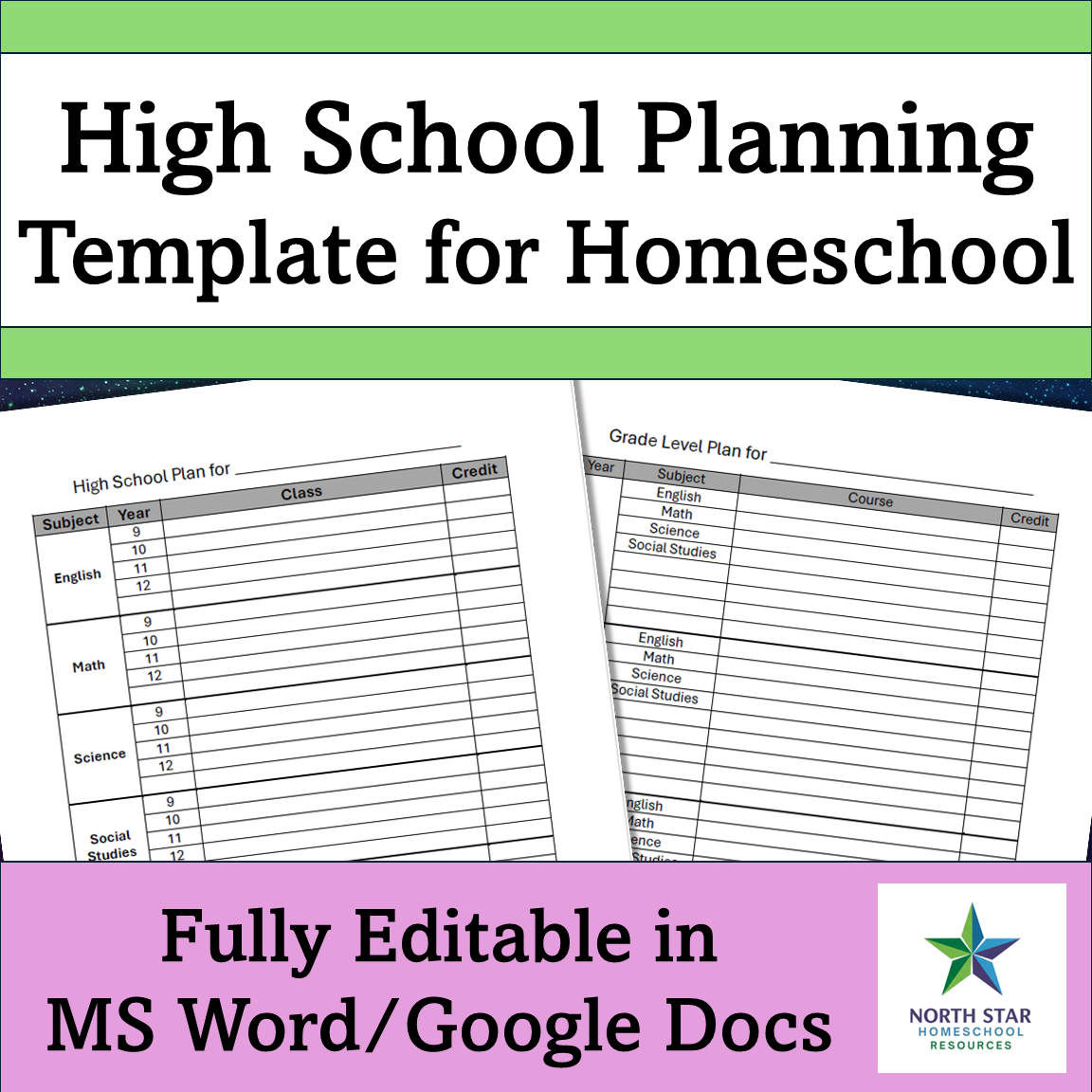
In the previous post, I shared the importance of having an overall plan for your homeschooled high schooler. For any journey, you must map the route to get to your destination. A template for laying out that educational pathway was also shared in that post to help with planning.
To a homeschooling parent new to high school, the options can seem overwhelming. With a solid plan in hand, you can stop worrying about logistics and start enjoying these final years of schooling together.
Let’s start with English Language Arts. In my state, Texas, graduates are expected to have four credits of English for the Foundation High School Program. As homeschoolers, we have the flexibility to choose the graduation requirements for our students, however if you have a college bound child it would be a good idea for their transcript to reflect a solid educational foundation in order to be competitive for admissions and scholarships.
An English class, such as English 1, English 2, or English 3, should include grammar, reading comprehension, vocabulary, literary analysis, and writing. Spelling may also be beneficial for students who struggle in this area. There are complete curricula that contain everything a student needs, such as The Good & The Beautiful High School ELA programs. My oldest two completed all three years and were well prepared for dual credit English Composition classes at the community college in 12th grade, so I recommend them for anyone looking for an all-in-one English program for high school ELA. (My youngest used TG&TB for all of elementary and middle school and flat out refused to use the curriculum for high school. Here is what we did for her ninth-grade year.) Other options for English credits include creative writing, American literature, British literature, world literature, journalism, and speech communication or public speaking. Prep Scholar has compiled a complete overview for each grade with Common Core Reading standards that is helpful if you are putting together the course yourself. If your student is ready for college level work, check out the dual credit offerings at your local community college.
Math requirements usually specify Algebra 1 and Geometry plus one more class, usually Algebra 2 as the bare minimum for high school. These three classes should prepare your child for College Algebra and beyond, depending on their post-graduation plans. In fact, your student may be ready for college math dual credit classes in 12th grade. Other popular options are Trigonometry or Pre-Calculus to prepare students for Calculus in college, if that is part of their chosen degree plan. I find math to be the area that requires the most flexibility in planning. Each of my children processes math differently and they have different plans for after graduation, so the math classes taken in 12th grade have been different as well. Statistics, computer programming, or an engineering class may be a better use of the “math slot” their senior year.
The first two to three years of science usually include Biology and Physical Science, Chemistry, or Physics. This is an area for fun and exploration! What interests your child about the world around the: Earth Science, Geology, Environmental Science, Organic Chemistry, Marine Biology, Zoology, Anatomy & Physiology, or Astronomy? If your student plans to pursue a science degree, I highly recommend taking biology, chemistry, and physics for the first three years to build a solid foundation of knowledge. In this case, dual credit science classes would be a great option for senior year! Otherwise, just let your student have fun exploring the science classes of their choice.
Social Studies options for the first three years usually include American History, World History or World Geography, and a year of one semester of US Government and one semester of Economics. Some American History courses are separated into two different years, Early American History and Modern American History. Again, depending on the college readiness of your student, taking a dual credit course in 12th grade is a great way to knock out high school graduation requirements and a class from a degree plan. Many colleges require two semesters of US History, divided as mentioned above, plus one to two semesters of government, and/or a world history or geography class for the social sciences core requirement. Sometimes social studies classes can be aligned with English options in 12th grade, such as World Geography and World Literature.
Languages other the English can be challenging if the household is only fluent in English, yet many colleges look for 2 years of Foreign Language on the transcript. Some colleges specify that two semesters of foreign language must be taken as part of the degree plan if not taken in high school. For American Sign Language and computer programming languages, check with your student’s intended college options to learn their policies. Some may count these as electives instead of Foreign Language credit.
For electives, Texas public schools require a year of Physical Education, a year of Fine Arts, and five additional electives. For homeschoolers, this is a pretty open area for students to pursue their interests. A child highly involved in dance and theater may use dance classes and performance for the PE credit and theater classes and productions for the fine arts requirement. As long as the course involves continuous instruction and some sort of performance or exhibition to showcase their work, I count the class on their transcript as an elective. I find the Carnegie Unit as a good benchmark for determining whether participation in an elective warrants a half credit or full credit for the year.
High school is an exciting time for your homeschooled student, but a time of increased responsibility for homeschool parents. We must get our children ready for life beyond our home. Whether they go directly into the work force, to trade school, to college, or take a leap year to decide, we need to help them be ready to take those next steps. Planning a path through high school will ease the yearly decision making and help your student stay focused on their graduation goals. By laying the groundwork now, you aren’t just building a transcript, you’re building your student’s confidence for the road ahead.


 North Star Homeschool Resources
One thought on “Tip #24: Choosing classes for your homeschool high school”